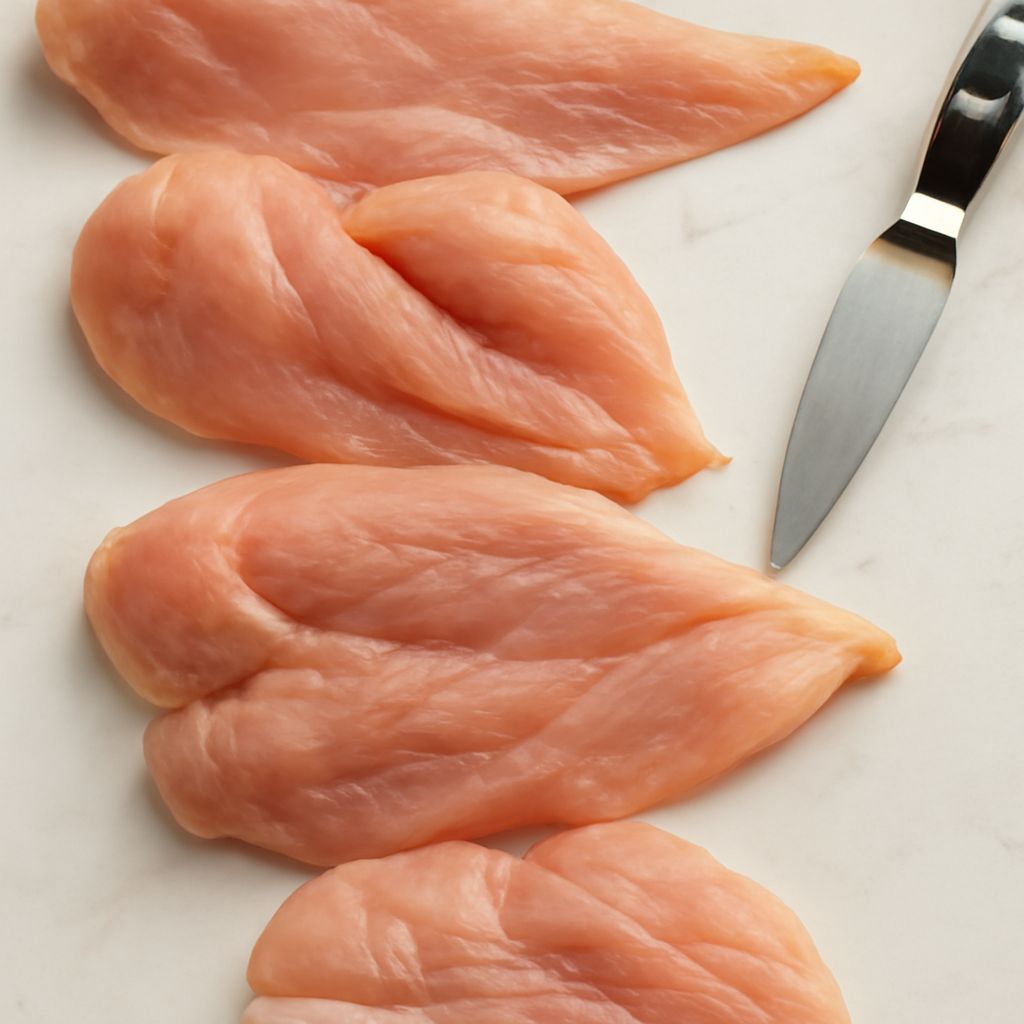
To learn how to slice chicken breast into even cutlets or strips, partially chill the meat first, stabilize your cutting board, and use a sharp knife. Trim the breast, identify the direction of the muscle fibers, then choose a horizontal cut for thin cutlets or a cross-grain cut for tender strips.
Work with raw chicken on a dedicated, clean cutting board. Keep the knife moving in long, smooth strokes rather than sawing, which can tear the meat and create uneven pieces.
Prepare and Orient the Breast
- Partially chill the chicken. Place the breast in the freezer for 15 to 30 minutes, depending on its size. The surface should feel firm but the center should not be frozen solid. Slightly chilled meat holds its shape and is easier to cut cleanly.
- Stabilize the board. Set the cutting board on a damp kitchen towel or nonslip mat. A board that shifts can cause uneven cuts and increase the chance of slipping with the knife.
- Trim the breast. Remove loose fat, cartilage, and any thin flap of meat. Leave the main breast intact so you can control its thickness as you slice.
- Flatten and orient it. Place the breast smooth-side down if it has a pronounced ridge, with the thickest section facing your dominant hand. Look for the grain: the faint muscle fibers usually run from the thick end toward the tapered tip.
Use a sharp chef’s knife or boning knife. A dull blade presses and tears instead of slicing. If the breast is very thick, avoid forcing the knife through it; make one controlled pass, reposition the meat, and continue from the same line.
How to Slice Chicken Breast Horizontally
Horizontal slicing creates thin cutlets for pan-frying, grilling, baking, and breading. This method is also called butterflying when you leave one edge attached.
- Lay the chicken flat on the board and place your nondominant hand on top, keeping your fingers curled away from the blade.
- Hold the knife parallel to the cutting board. Start at the thickest side and make a long, level cut through the middle of the breast.
- Stop just before cutting all the way through if you want a butterfly shape. Open the breast like a book. For separate cutlets, continue through the hinge and divide the pieces.
- Check the thickness. If one area is much thicker, rotate the cutlet and make a second shallow pass rather than pressing down aggressively.
Aim for cutlets about 1/2 inch thick for even cooking. Very thin cutlets, around 1/4 inch, suit quick sautés and breading but can dry out quickly. If the meat stretches, shreds, or looks ragged, chill it longer or sharpen the knife before continuing.
How to Cut a Chicken Breast into Strips
For strips, first decide whether you need tender bite-size pieces or long strips for a stir-fry, fajitas, or a salad. The key is to cut across the grain so each piece contains shorter muscle fibers.
- Place the breast flat and locate the direction of the fibers. If they run from left to right, your cuts should travel from top to bottom.
- For short, tender strips, cut the breast crosswise into sections about 1 to 2 inches wide. Turn each section, then slice it into strips of equal width.
- For longer strips, angle the knife slightly across the grain instead of cutting straight across. A diagonal cut creates length while still shortening the fibers.
- Keep the knife nearly perpendicular to the board and use a smooth forward stroke. Avoid chopping straight down, which compresses the meat and produces ragged edges.
Cut chicken breast into strips about 1/4 to 1/2 inch wide when you need quick, even cooking. Arrange the finished pieces in a single layer so you can compare their sizes before they go into the pan.
Match Thickness When You Cut Chicken Breast
Thickness controls both texture and cooking time. Thin cutlets and narrow strips cook quickly, while thick pieces take longer and are more likely to brown outside before the center is done. Keep each batch as uniform as possible rather than mixing 1/4-inch strips with thick chunks.
- Thin cutlets: Use about 1/4 inch for fast sautés, breaded chicken, or recipes where the meat will finish in sauce.
- Standard cutlets: Use about 1/2 inch for grilling, baking, or pan-cooking with a browned exterior.
- Thick slices or strips: Use 3/4 inch or more when you want a substantial bite, but allow extra cooking time and avoid crowding the pan.
Across-grain cuts feel more tender because the knife shortens the muscle fibers. A shallow diagonal angle makes strips longer; a straight cross-grain angle makes them shorter and usually more tender. Cook the pieces until the thickest part reaches 165°F. Evenly cut chicken should cook at a similar rate, with no translucent center or raw-looking seam.