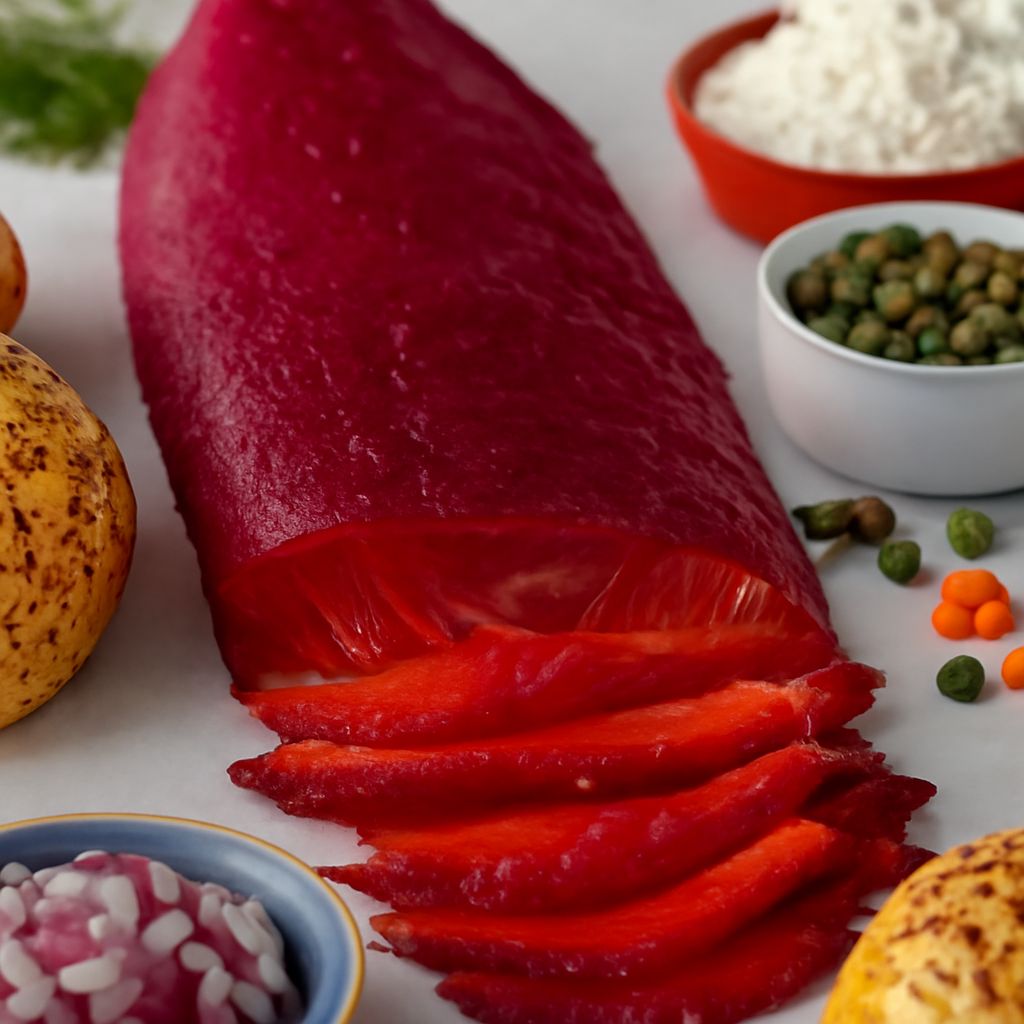
Make salmon gravlax with a simple weight-based cure: use 4% salt and 4% sugar relative to the fish. For a 1 kg salmon fillet, that means 40 g salt and 40 g sugar. After 24 to 48 hours in the refrigerator, the cure produces firm, sliceable fish without heat.
Fish thickness controls the timing more than total weight. A thin fillet may be ready in 24 hours, while a thick center-cut piece usually needs 36 to 48 hours. Turn the wrapped fish during curing so the salt, sugar, and moisture distribute evenly.
Salmon gravlax ingredients: 1 kg fish, 40 g salt, 40 g sugar
- 1 kg salmon fillet, skin on or off, pin bones removed
- 40 g fine sea salt
- 40 g granulated sugar
- 30 g fresh dill, roughly chopped, plus more to serve
- 2 teaspoons coarsely ground black pepper
- Optional: finely grated zest of 1 lemon
The 40 g salt and 40 g sugar amounts each equal 4% of the salmon weight. For 500 g of fish, use 20 g of each; for 1.5 kg, use 60 g of each. Weigh the ingredients for consistent seasoning, especially if your salt crystals vary in size. Choose a thick, even fillet when possible, or divide an irregular piece into sections so thinner portions do not overcure while the center catches up.
Apply, wrap, weight, and refrigerate the cure
- Pat the salmon completely dry and remove any remaining pin bones. Mix the salt, sugar, pepper, and lemon zest in a bowl.
- Place the salmon skin-side down in a rimmed dish. Cover the flesh evenly with the cure, then press the dill over the surface. Make sure the thickest areas receive the same coverage as the edges.
- Wrap the salmon tightly in plastic wrap. If you are curing two fillets, place them flesh-side together before wrapping. Put the package in a dish to catch the liquid released during curing.
- Set a flat plate, small tray, or another dish on top of the wrapped salmon. Add a light, evenly distributed weight, such as two cans. The pressure should keep the fish in close contact with the cure, not flatten it.
- Refrigerate immediately. Keep the package cold and undisturbed for the first 12 hours while the salt begins drawing out moisture.
As the cure works, liquid will collect in the package. That brine is expected; it helps season the fish as it presses against the flesh. Do not leave the salmon at room temperature, and do not add extra cure simply because liquid appears.
Turn the salmon for gravlax and check 24–48-hour doneness cues
After 12 hours, remove the weight and turn the package over. If the fish is in two pieces, reverse their positions so the upper and lower pieces exchange contact with the brine. Rewrap tightly, replace the weight, and return the salmon to the refrigerator. Turn it once more at 24 hours if you plan to cure it for 36 to 48 hours.
Begin checking a thin fillet at 24 hours and a thick center-cut fillet at 36 hours. The finished cured salmon for gravlax should feel noticeably firmer than raw fish, with a dense outer layer and a slight, even yield in the center. The flesh should look glossy and moist but not loose or watery. If the center still feels soft and leaves a deep impression when pressed, rewrap and continue curing for 6 to 12 hours. If the fillet feels hard, dry, or leathery at the edges, finish it promptly rather than extending the cure.
Finish the cured salmon for gravlax, slice against the grain, and serve
Unwrap the salmon and scrape away the dill and excess cure. Taste a thin piece from the end. If it is aggressively salty, rinse the surface very briefly under cold water and pat it completely dry; otherwise, simply wipe it clean. Remove the skin by sliding a sharp knife between the skin and flesh.
Chill the fillet for 20 to 30 minutes if it feels soft, then slice it with a long, thin knife. Look for the muscle lines running along the fillet and cut across them, not parallel to them. Hold the knife at a shallow angle and draw it toward you in one smooth stroke to create thin, broad slices. Avoid sawing, which tears the surface and produces thick, uneven pieces.
Serve the gravlax-style salmon on rye or crispbread with mustard-dill sauce, cucumber, capers, pickled red onion, or lemon. Keep the finished slices tightly covered and refrigerated, and slice only what you plan to serve so the remaining fillet stays moist.