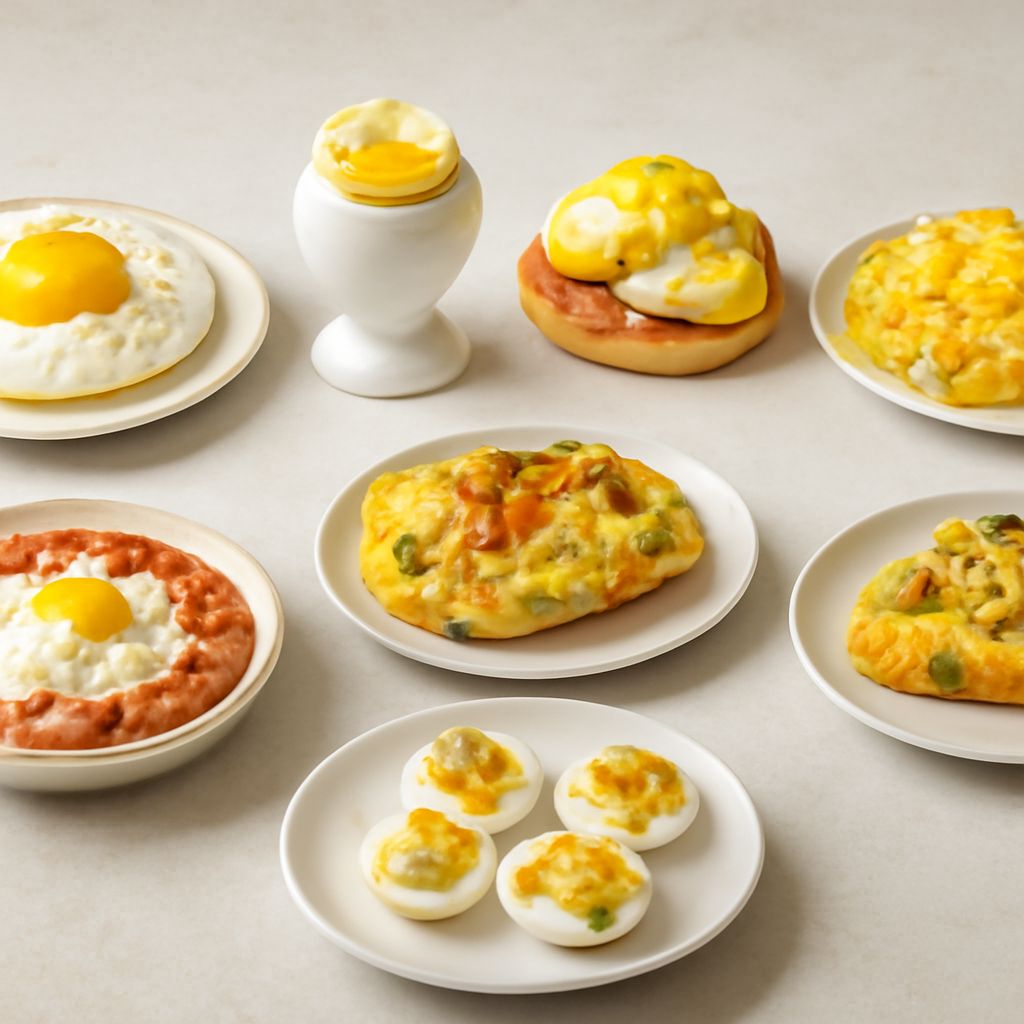
You can sort the main types of cooked eggs by cooking method, then by how firmly the white and yolk set. The most useful egg styles to recognize are fried, boiled, poached, scrambled, baked, and folded preparations.
The style of eggs you order affects texture more than flavor: a runny yolk adds sauce, a fully set yolk is easier to slice, and gentle cooking usually produces softer whites. Use the terms below to know what will arrive and how to order it.
Types of cooked eggs by method
Menus may use slightly different names, but these categories cover the common preparations:
- Fried: Cooked in a pan, with the white and yolk exposed to direct heat.
- Scrambled: Beaten eggs stirred as they cook into curds that range from soft to firm.
- Poached: Cracked into simmering water, producing a tender white around a liquid yolk.
- Boiled: Cooked in the shell until the yolk is soft, creamy, or fully firm.
- Baked: Cooked in a dish or shell-less mixture in the oven until set.
- Folded: Cooked as a flat layer and folded around fillings, as with an omelet.
When a menu lists “two eggs,” ask for the preparation and doneness separately. For example, “two eggs over medium” gives both the cooking method and the expected yolk texture.
Fried egg styles: white and yolk doneness
Fried egg terminology mainly describes whether the egg is flipped and how much heat reaches the yolk. The white should be set unless you specifically request a softer preparation.
- Sunny-side up: The egg is not flipped. The white sets from the bottom while the yolk remains visibly bright and runny. The edges may be delicate or crisp, depending on the pan temperature.
- Over easy: The egg is flipped briefly. The white is set, but the yolk stays liquid and flows when cut.
- Over medium: The egg is flipped longer. The white is fully set, and the yolk becomes thick, jammy, or partly set rather than completely liquid.
- Over hard: The egg is flipped until the yolk is fully firm. The yolk may break during cooking and will not run when sliced.
- Over well: Usually means a thoroughly cooked fried egg with a firm yolk and firm white. Some restaurants use it interchangeably with over hard.
- Basted: The egg is generally not flipped; hot oil, butter, or steam cooks the top. The white becomes more evenly set while the yolk often remains runny.
For a runny yolk with crisp edges, order “sunny-side up.” For a runny yolk with a cooked top, choose “over easy” or “basted.” Request “over medium” for a soft center that will not spread as quickly.
Boiled, poached, and scrambled egg textures
Boiled eggs are classified by the yolk rather than by whether the shell stays intact. Timing varies with egg size and starting temperature, so visual texture is the best guide.
- Soft-boiled: The white is set, while the yolk is liquid or partly liquid. The center is ideal for dipping toast.
- Medium-boiled: The yolk is thicker and custardy, with little or no liquid center.
- Hard-boiled: Both white and yolk are fully firm. A properly cooked yolk should be tender, not dry or gray around the edge.
Poached eggs have a soft, shapely white and a liquid or gently thickened yolk. They are common on eggs Benedict, toast, and grain bowls. If the white spreads into loose strands, the egg is less neatly poached, but the texture can still be tender.
Scrambled eggs are usually described as soft, medium, or well done. Soft scrambles have moist, glossy curds and finish cooking from residual heat. A firmer scramble has larger, drier curds and holds its shape. If you want creamy eggs, ask for them soft and remove them from the heat before they look completely dry.
Baked and folded egg dishes: menu terms to know
Baked eggs cook with steady surrounding heat, so the texture can range from tender custard to a fully firm slice. “Shirred eggs” are eggs baked in a shallow dish, often with butter or cream; the white sets while the yolk may remain soft. “Baked eggs” can also refer to eggs cooked in tomato sauce, vegetables, or other ingredients.
- Frittata: Beaten eggs mixed with fillings such as vegetables, cheese, or meat, then cooked until firm, usually in a skillet and sometimes finished in the oven. It is thicker and more sliceable than a basic omelet.
- Quiche: A baked egg custard, commonly set with cream and fillings inside a pastry crust. Its interior should be tender and cohesive, not liquid.
- Omelet: Beaten eggs cooked into a thin, tender layer and folded around fillings. A French-style omelet is soft and pale; a diner-style omelet is usually firmer and more browned.
- Egg crepe or folded eggs: A thin egg layer wrapped around vegetables, cheese, or meat. It should be flexible enough to fold without cracking.
To order clearly, name the dish first and the yolk preference second: “a baked egg with a runny yolk,” “a soft scramble,” or “a cheese omelet, lightly browned.”