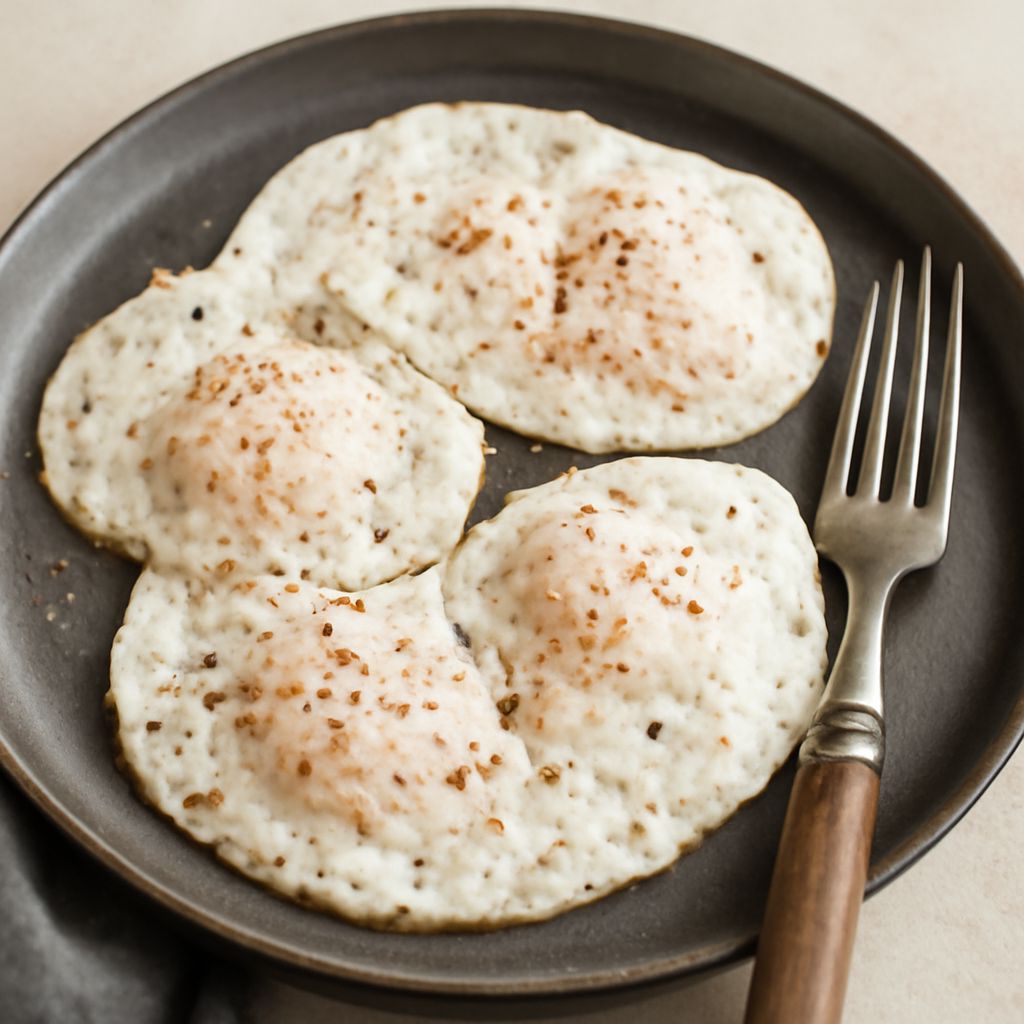
Egg styles are easiest to understand by looking at two results: how firmly the white is set and how much the yolk has cooked. Cooking movement matters too. A fried egg may stay still in the pan, flip once, or cook until the yolk is firm, while scrambled eggs are stirred into curds.
The different styles of eggs below translate common menu terms into the textures you will see on the plate. Restaurant terminology can vary, so describe the white and yolk you want when the exact label is unclear.
Fried Egg Styles by Yolk Doneness
The main fried egg styles differ by whether the egg is flipped and how far the yolk cooks. In every version, you can also request crisp or tender edges and fully set whites.
- Sunny-side up: The egg cooks on one side without flipping. The white should become opaque and set, while the yolk remains visible on top and usually runny. If you dislike translucent egg white, ask for “sunny-side up with the whites fully set.”
- Over easy: The egg is flipped briefly after the bottom sets. The white is cooked through, but the yolk stays liquid and may spill when you cut it.
- Over medium: The egg is flipped and cooked longer. The white is fully set, and the yolk is partly set with a thick, jammy center. It should not be completely liquid, but it should still feel soft.
- Over hard: The egg is flipped and cooked until the yolk is completely firm. The white and yolk have a solid texture, with no runny center.
Pan heat changes the edges more than the basic yolk terms. A hot pan can produce browned, crisp edges, while lower heat creates smooth, tender whites. “Over” describes the flip, not the level of browning. A sunny-side-up egg has no flip even if the cook covers the pan or spoons hot fat over the top.
Different Styles of Eggs: Scrambled, Poached, and Boiled
Scrambled eggs are beaten before cooking and moved around the pan as they thicken. The movement creates curds rather than one continuous white and yolk.
- Soft scrambled: Large, tender curds remain glossy and moist, with no visible liquid egg pooling on the plate. Remove them from the heat just before they look fully done because carryover heat continues cooking them.
- Medium scrambled: The curds are set but still tender. They look matte rather than wet and hold their shape when lifted.
- Hard scrambled: The eggs are fully firm and usually drier, smaller, or more browned. Ask for “well-done scrambled eggs” if you want no soft or glossy areas.
Poached eggs cook without their shells in gently simmering water. The white forms a soft, irregular shape around the yolk. A properly poached egg has a set white and a liquid yolk, although longer cooking can make the center thicker or firm. Request “poached with a runny yolk” or “poached until jammy” to make the result clear.
Boiled eggs cook in their shells, so the white and yolk set from the outside inward. A soft-boiled egg has a firm white and a liquid yolk. A jammy egg has a fully set or nearly set white and a thick, spreadable yolk that is softer than hard-boiled. A hard-boiled egg has a firm white and a fully set, sliceable yolk. Timing varies with egg size, starting temperature, and cooking method, so texture is a better order than an exact minute count.
Baked and Folded Egg Dishes
Baked eggs usually develop a set white and a yolk that ranges from runny to firm, depending on how long the dish stays in the oven. Because the egg continues cooking in a hot dish, ask for the yolk texture you prefer before ordering.
- Baked or shirred eggs: Eggs cook in a small dish, often over butter, cream, vegetables, or sauce. The edges of the white set first, while the yolk can remain runny. A longer bake produces a firm yolk.
- Frittata: Beaten eggs cook with vegetables, cheese, meat, or herbs in a pan, then finish on the stovetop or in the oven. The result is sliceable and cohesive, with a tender, fully set interior rather than separate curds.
- Omelet: Beaten eggs cook as a thin sheet and fold around a filling. A diner-style omelet is usually fully set and sturdy; a French-style omelet is softer, pale, and often slightly creamy inside.
“Baked” tells you how the egg was heated, while “omelet” and “frittata” describe the finished form. These names are not perfectly standardized, so use “soft inside,” “fully set,” or “no runny egg” when texture matters most.
Ordering Eggs by White and Yolk Texture
When ordering eggs, name the cooking style first and then specify the white and yolk. This gives the kitchen a visible target instead of relying on a label that may mean different things from one restaurant to another.
- For a runny yolk: Say, “Two eggs over easy, with the whites fully set and the yolks runny.” For an unflipped egg, ask for “sunny-side up with set whites and a liquid yolk.”
- For a thick, soft yolk: Say, “Over medium, with jammy yolks.” You can add “no liquid center” if you want the yolk to hold its shape when cut.
- For a firm yolk: Say, “Over hard, with the yolks completely set.” This is clearer than simply asking for well-done eggs.
- For moist scrambled eggs: Order “soft scrambled, tender and still moist.” If you want a firmer result, ask for “hard scrambled” or “well-done scrambled.”
- For poached eggs: Request “poached with fully set whites and runny yolks,” or “poached until the yolks are jammy.”
- For boiled eggs: Say “soft-boiled with a liquid yolk,” “jammy in the center,” or “hard-boiled with a fully firm yolk.”
If the menu uses only “fried,” ask whether the egg will be flipped and state your preference: “Please fry it without flipping, with the white fully set and the yolk runny,” or “Please flip it and cook the yolk until firm.”