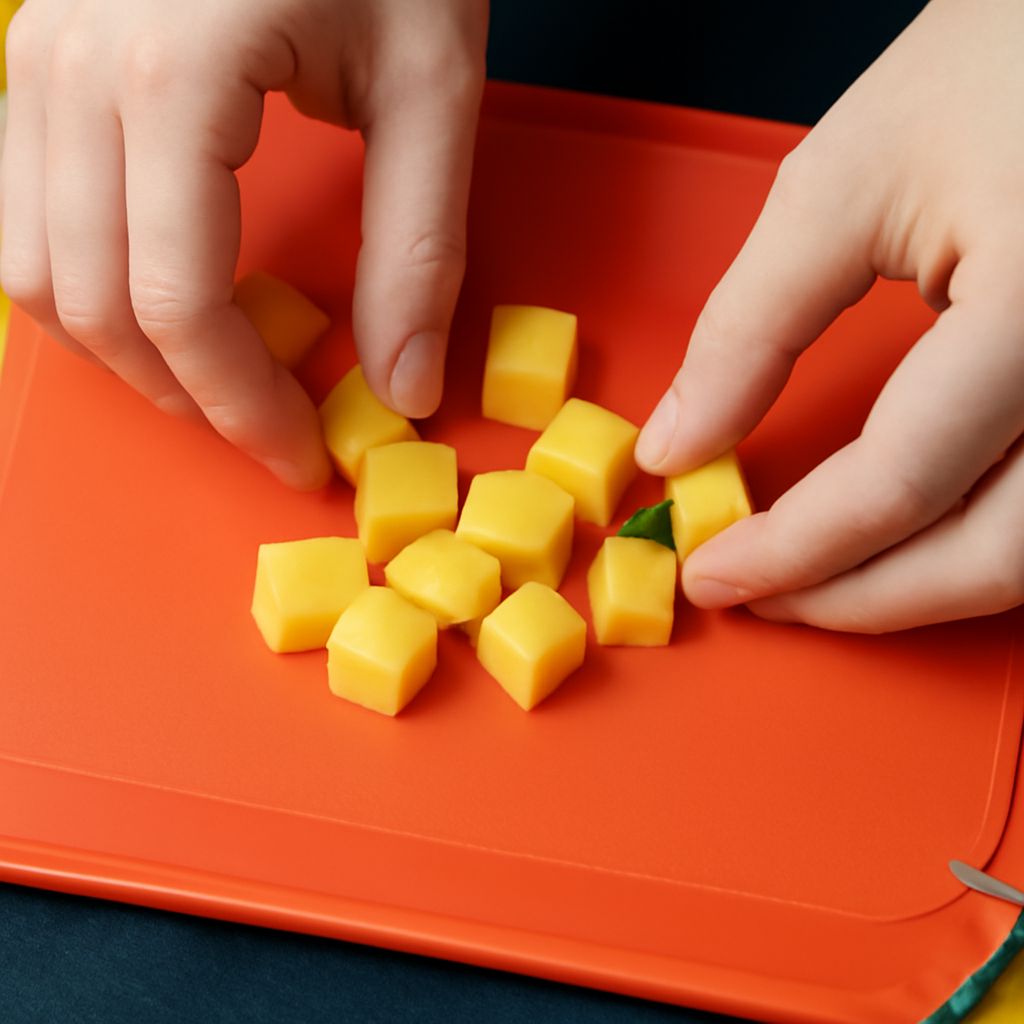
How to cube potatoes evenly, start by creating one flat side so the potato cannot roll. Then cut it into equal planks, turn those planks into sticks, and crosscut the sticks into cubes. This sequence gives you consistent pieces with less waste and safer knife control.
Use a sharp chef’s knife, a stable cutting board, and potatoes that are similar in size when you need even cooking. You can peel them or leave the skins on, depending on the dish.
How to Cube Potatoes: Choose a Size for Roasting, Soup, or Boiling
Choose the cube size before you make the first cut. The thickness of your planks, sticks, and final crosscuts should all match. Uniform pieces cook at the same rate; mixed sizes leave you with undercooked centers and over-soft edges.
- 1/4-inch cubes: Use these for quick-cooking hash, garnishes, or very fine soup vegetables. They usually boil in about 5 to 8 minutes and roast in roughly 15 to 20 minutes at 425°F, though they can dry out quickly.
- 1/2-inch cubes: These work well in soup, hash, skillet dishes, and fast roasting. Expect about 8 to 10 minutes in boiling water or 20 to 25 minutes in a hot oven.
- 3/4-inch cubes: Choose this versatile size for roasted potatoes, chowders, casseroles, and pan cooking. They typically boil in 10 to 15 minutes and roast in about 25 to 35 minutes at 425°F.
- 1-inch cubes: Use larger cubes for chunky soup, stew, and hearty roasted potatoes. They generally need 15 to 20 minutes to boil or 35 to 45 minutes to roast at 425°F.
These times assume you start with pieces at room temperature and cook them in a single layer or in plenty of water. Test a cube with a fork near the shorter end of the range. It is ready when the fork slides into the center with slight resistance for roasting or almost no resistance for boiling.
How to Cube a Potato on a Stable Cutting Base
- Set up the board. Place a damp kitchen towel beneath the cutting board so it cannot slide. Use a sharp chef’s knife, preferably 8 inches long, and keep the blade pointed away from your free hand.
- Prepare the potato. Scrub and dry it. Peel it if the recipe calls for peeled potatoes. Cut off only the stem and sprout ends. If the potato is especially long, cut it crosswise into two manageable sections.
- Make a flat base. Set each section lengthwise on the board and slice a thin piece from one rounded side. Turn the potato so this cut side rests flat. For a very irregular potato, trim one more narrow strip from the opposite side, but avoid cutting away large amounts of usable potato.
- Use a claw grip. Curl the fingertips of your non-knife hand so the fingertips point down and your knuckles face the knife. Hold the potato gently against the board with your knuckles guiding the blade. Keep your thumb behind your fingers rather than extended along the potato.
- Control the knife. Use a smooth forward-and-down motion instead of forcing the blade straight down. Keep the knife tip near the board if that feels natural, or lift the entire blade for short, controlled cuts. If the potato rocks, stop and create a larger flat surface before continuing.
A stable potato should stay still when you press it lightly. If it slides, spins, or tips toward the knife, do not try to hold it harder with your fingertips. Reposition it on the flat side or trim a small additional slice. Stability is more important than keeping every last edge.
How to Cut Potatoes Into Cubes: Planks, Sticks, and Final Cuts
- Cut the planks. With the flat side down, slice the potato lengthwise into slabs. Make each slab the same thickness as your target cube: 1/2 inch for 1/2-inch cubes, 3/4 inch for 3/4-inch cubes, and so on. Keep the cuts parallel. If the potato is wide, work from one side across rather than trying to span the entire width in one awkward motion.
- Stack only stable planks. Align two or three slabs with their flat faces together. Do not make a tall stack if it wobbles. For a long potato, cut the planks crosswise into shorter sections before stacking them.
- Cut the sticks. Slice through the stack lengthwise at the same spacing used for the planks. These long strips, sometimes called batons, should be the same width as their height. Separate them if they begin to slide.
- Make the final crosscuts. Rotate the sticks 90 degrees, keep them aligned, and cut across them at the target spacing. A 3/4-inch interval creates approximately 3/4-inch cubes. Use your knuckles as a guide and move the guiding hand backward after every cut.
- Check the pieces. Look for any pieces that are noticeably larger than the rest. Cut oversized pieces down before cooking. Thin scraps and tapered edge pieces can go into soup, mashed potatoes, or a separate batch where exact timing matters less.
For the most even results, measure the first plank against the knife blade or a ruler, then use it as your visual guide. You do not need to measure every cut. Keep your cuts parallel and repeat the same spacing. A cube is finished when all three dimensions are close to the same size, not merely when the pieces look roughly square from above.
To cube potatoes quickly, avoid cutting individual pieces one at a time. The plank-to-stick-to-cube sequence is faster and produces more consistent results. However, reduce the stack height whenever it feels unstable. Two steady planks are safer and more accurate than six sliding ones.
Cubing Potatoes Without Discoloration
Freshly cut potatoes can turn gray, pink, or brown when their exposed surfaces react with air. The color change does not usually mean the potato is spoiled, but it can make the pieces look unappealing. Keep the cubes submerged in cold water as soon as you finish cutting them.
- Put the cubes in a bowl of cold water while you finish the rest of the potatoes.
- Make sure the water covers every piece. A plate or small lid can weigh down floating cubes.
- Rinse once or twice if you want to remove excess surface starch, especially for roasting or frying.
- Drain and pat the potatoes thoroughly dry before roasting, pan-frying, or air-frying. Wet surfaces steam instead of browning.
For boiling or adding the cubes directly to soup, you can transfer them from the water to the pot after draining. Do not leave cut potatoes submerged indefinitely; use them within a few hours for the best texture, and keep them chilled if preparation must wait.