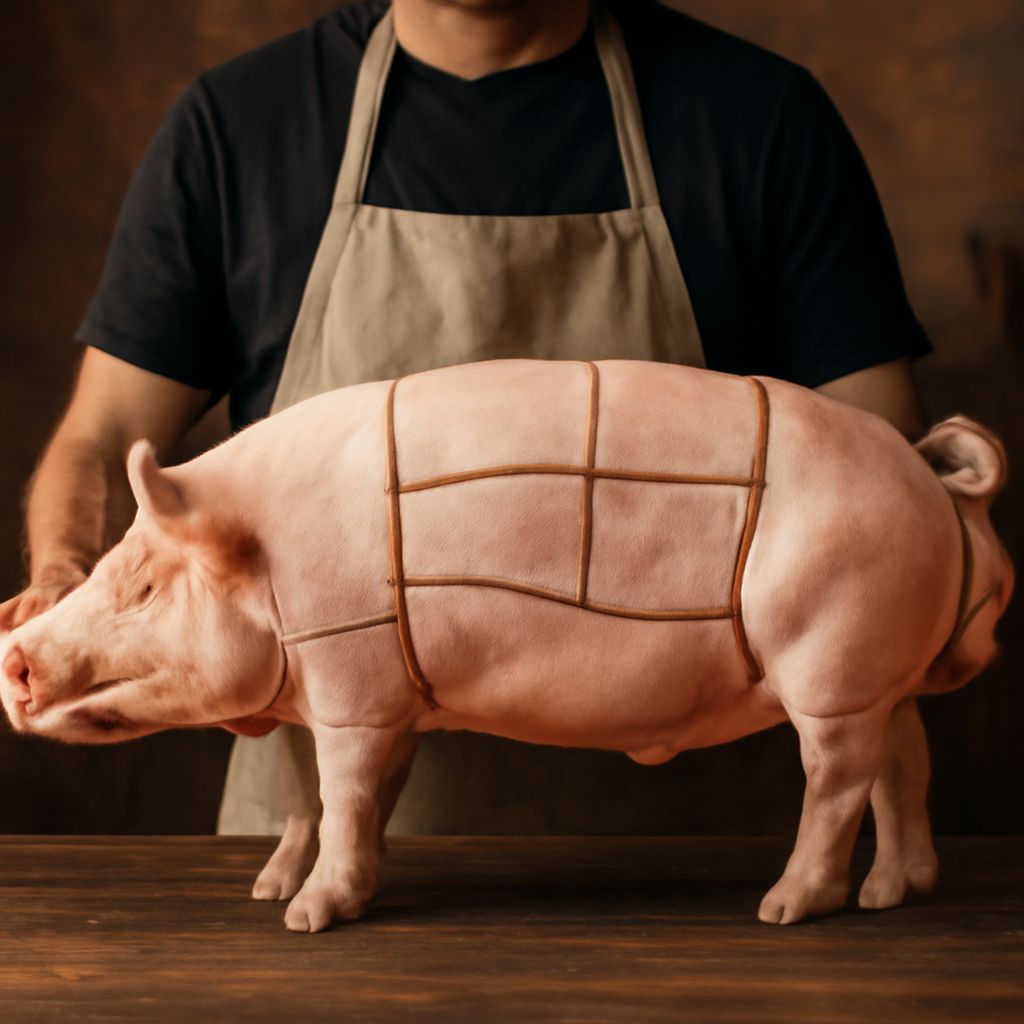
A pork cuts diagram becomes easier to use when you read it from the animal’s front to its rear: shoulder, loin, belly and ribs, then leg. The labels show where each primal section sits, while the retail names identify the chops, roasts, ribs, bacon, ham, and hocks you see at the meat counter.
Most diagrams show the pig in side profile with the head to the left and the rear leg to the right. Some reverse that view, so first locate the neck, spine, belly line, hip, and lower leg before matching any label.
How to Read a Pork Cuts Diagram From Front to Back
Start at the front shoulder, where the neck meets the upper foreleg. The shoulder extends backward to the area just before the loin and downward toward the elbow. It is heavily exercised, so it contains more connective tissue and benefits from slow cooking.
The loin runs along the top of the pig, behind the shoulder and below the backbone. Its front boundary begins near the last shoulder cuts; its rear boundary reaches the hip and sirloin area. The tenderloin lies inside the body cavity beneath the loin, so a simple side-view diagram may show it separately or not at all.
Below the loin, you will usually see the rib and belly regions. The ribs sit against the backbone and curve downward into the side. The belly occupies the lower side and continues toward the rear flank. At the back, the leg begins around the hip and extends to the hock, the joint above the foot.
Use the diagram’s lines as practical boundaries rather than exact butchery rules. Butchers can divide the same muscle group differently, and a retail label may describe a sub-cut, a cooking preparation, or a regional name.
Translate a Pork Cut Diagram Into Primal Sections
A pork cut diagram typically groups many retail cuts into a few large sections, called primal cuts. These are the main areas to identify:
- Shoulder: The front upper section, including the butt and picnic shoulder.
- Loin: The back section between the shoulder and hip, producing chops, loin roasts, tenderloin, and sirloin cuts.
- Rib area: The bones and meat running below the backbone, producing back ribs and spare ribs.
- Belly or side: The fatty lower middle section used for bacon, fresh belly, and some spare-rib cuts.
- Leg: The rear section above the hock, sold fresh or cured as ham.
- Smaller sections: The jowl, hocks, feet, cheek, and tail may appear around the edges of a detailed chart.
These sections do not always appear as six equal blocks. In many American charts, the ribs are treated as part of the loin or belly rather than as a separate primal. A chart can also label “side” instead of “belly,” especially when it groups the belly with the flank and rib area.
Shoulder, Loin, and Rib Sections on a Pork Cuts Chart
The upper shoulder, often labeled Boston butt or pork butt, sits behind the neck and above the lower shoulder. Despite its name, it is not from the rear of the pig. It contains well-marbled muscles suited to pulled pork, barbecue roasts, stews, and braises.
The lower front section is the picnic shoulder. It includes muscles closer to the foreleg and often has skin and a different bone shape from the butt. You can roast or smoke it, but it generally needs the same low, slow treatment as other shoulder cuts.
The loin is the leanest major section. Moving from front to back, it yields bone-in loin chops, center-cut chops, boneless loin chops, rib chops, loin roasts, and sirloin roasts. The tenderloin is a narrow, especially tender muscle from the inside of the loin. Use loin chops and roasts for roasting, grilling, or pan-searing; cook tenderloin quickly and avoid overcooking it.
The rib labels depend on their position. Baby back ribs, also called loin back ribs, come from the upper rib cage next to the loin. They are shorter and leaner. Spareribs come from the lower rib area near the belly and are broader and fattier. St. Louis-style ribs are trimmed spareribs with a more uniform rectangular shape. All three are commonly smoked, grilled, or oven-braised until tender.
Belly, Side, and Leg Sections on a Cuts of Pork Diagram
On a cuts of pork diagram, the belly appears beneath the loin and behind the front shoulder. It is a layered cut of meat and fat, which makes it the source of most American-style bacon. Retailers may sell it as pork belly, fresh side, or side pork. Fresh belly can be roasted, braised, or grilled; cured belly becomes bacon after curing and usually smoking or cooking.
The side section may include the lower ribs, belly, and flank depending on the butcher’s system. This explains why one chart may place spare ribs beside the belly while another places them under the rib or loin section. The labels overlap because the cuts share a seam rather than a naturally visible line.
The rear leg begins at the hip and continues down to the hock. A fresh leg may be sold as a leg roast, fresh ham, or pork leg. Once cured and often smoked, it becomes the ham used for whole hams, half hams, and ham steaks. The upper leg is relatively lean and suits roasting; the lower leg contains more connective tissue.
The hock, sometimes called the shank in retail descriptions, is the lower joint between the leg and foot. It adds collagen and flavor to braises, beans, soups, and greens. The jowl or cheek sits at the head end and is often cured as jowl bacon or used in sausages. Feet and tails are smaller, collagen-rich cuts commonly braised or added to stocks.
Retail Names and Cooking Methods on a Cuts of Pork Chart
Use this cuts of pork chart translation when a retail name does not match the label on your diagram:
- Pork butt or Boston butt: Upper shoulder; smoke, braise, or slow-roast for shredding.
- Picnic shoulder: Lower shoulder; roast or smoke slowly, often with the skin attached.
- Loin chop or loin roast: Back section; grill, pan-sear, or roast with care because it is lean.
- Tenderloin: Inner loin muscle; sear, grill, or roast quickly.
- Baby back ribs: Upper ribs beside the loin; cook with moderate, slow heat.
- Spareribs or St. Louis ribs: Lower ribs near the belly; smoke, braise, or grill slowly.
- Pork belly or side pork: Lower middle section; roast or braise fresh, or cure for bacon.
- Ham or fresh ham: Rear leg; roast fresh, or cure and smoke.
- Hock or shank: Lower leg joint; braise or simmer until tender.
Regional naming can change how you read a chart. “Pork butt” and “Boston butt” usually mean the same upper-shoulder cut in the United States, while “ham” may mean the fresh leg or the cured product. “Country-style ribs” can come from the blade end of the loin or from the shoulder, depending on the butcher. Check the cut’s location and bone shape when the retail name conflicts with the diagram.