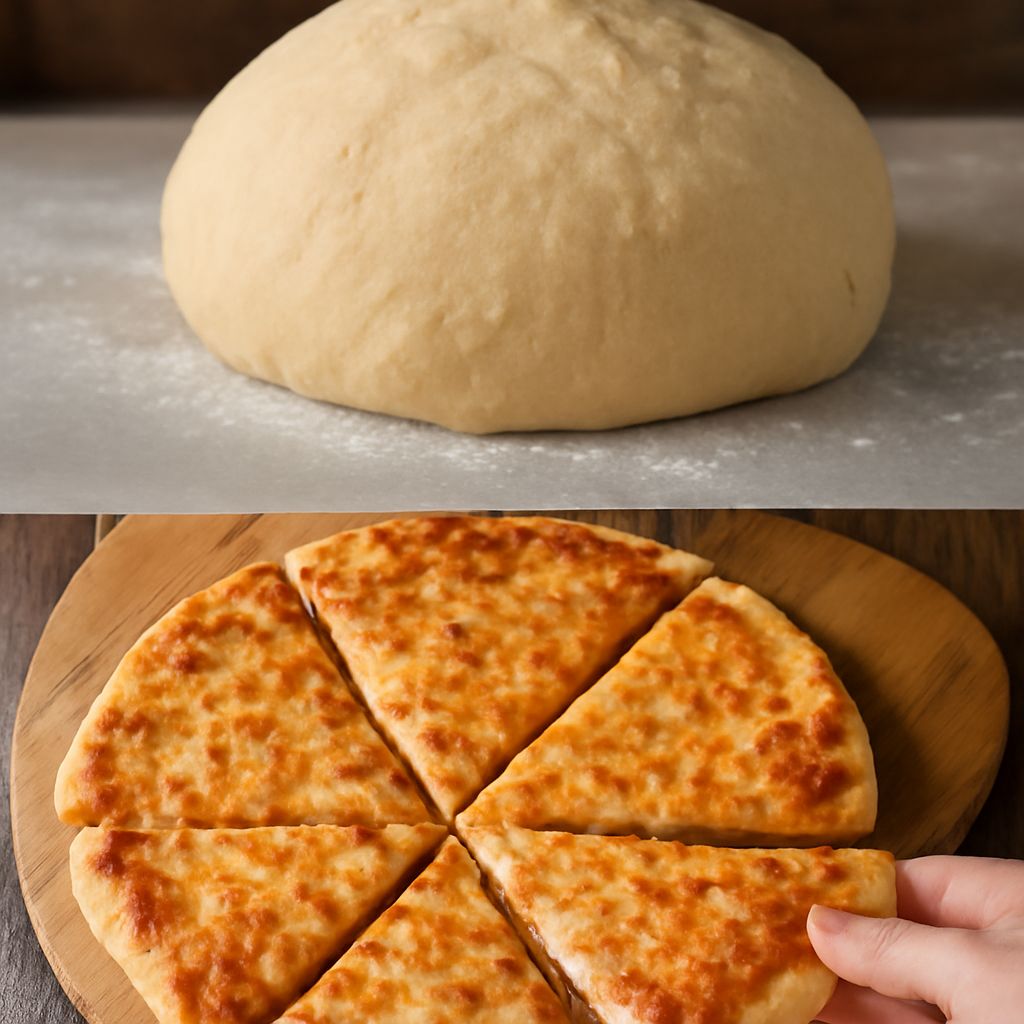
This chewy pizza dough recipe makes two 12-inch pizzas with crisp edges, an airy rim, and a resilient center that stays pleasantly chewy rather than dense. You’ll use strong flour, 70% hydration, a long cold ferment, and a fully heated baking surface to build that texture.
Plan ahead: the dough needs at least 24 hours in the refrigerator, although 48 hours gives you deeper flavor and an easier-to-stretch dough. The finished dough weighs about 862 grams, or 431 grams per pizza.
Ingredients for a Chewy Pizza Dough Recipe (500 g Flour, 350 g Water, 10 g Salt, 2 g Yeast)
Yield: Two 12-inch pizzas
- 500 g strong bread flour, ideally 12.5% to 14% protein
- 350 g water, divided; cool water works best for a long ferment
- 10 g fine sea salt
- 2 g instant yeast
Water makes up 70% of the flour’s weight, a hydration level high enough for an open, chewy crumb without making the dough unmanageably slack. Strong flour supplies more gluten-forming protein, so the dough can hold that water, develop structure, and stretch without tearing. Salt strengthens the gluten and controls fermentation; the small amount of yeast supports a slow rise and fuller flavor.
Mix and Ferment: How Hydration Builds Chewy Pizza Dough
- Put the flour and 330 g of the water in a large bowl. Mix until no dry flour remains, then cover and rest for 20 to 30 minutes. This short rest lets the flour hydrate before you develop the gluten.
- Add the remaining 20 g water, instant yeast, and salt. Pinch and fold the dough until the additions disappear, then knead by hand for 6 to 8 minutes. The dough should become smoother and elastic, with a tacky surface but no loose, batter-like consistency. If it tears immediately when stretched, knead for another minute or two.
- Cover the bowl and let the dough rise at room temperature for 60 to 90 minutes. During the first hour, complete two folds at 30-minute intervals: pull one side up and fold it over the center, rotating the bowl until you’ve folded all four sides. Stop the bulk rise when the dough has expanded by roughly one-third to one-half, not necessarily doubled.
- Cover tightly and refrigerate for 24 to 72 hours. The cold fermentation allows the gluten to mature while the yeast slowly develops flavor. For the best balance of flavor and handling, use the dough after about 48 hours.
Remove the dough from the refrigerator 2 to 3 hours before baking. Divide it into two 431 g portions, gently tuck the edges underneath to make smooth balls, and place them seam-side down in lightly oiled, covered containers. Let them warm and relax at room temperature. Properly fermented dough should feel airy and extensible; if it remains tight, give it another 20 to 30 minutes.
Shape for a Crisp-Edged Chewy Pizza Crust
Set one dough ball on a lightly floured surface and dust the top sparingly. Press from the center outward with your fingertips, leaving a 1-inch untouched border for the rim. Turn the dough as you work, then lift and stretch it over your knuckles until it reaches 12 inches. Keep the center thin to medium-thick, but avoid flattening the edge or pressing out its gas.
Do not use a rolling pin; it compresses the fermentation bubbles that create a light, chewy pizza crust. If the dough keeps shrinking, cover it and rest it for 10 to 15 minutes before stretching again. Transfer the shaped dough to a lightly floured or semolina-dusted peel, then add a moderate layer of sauce and toppings. Heavy toppings can weigh down the center and prevent it from baking crisp.
Bake at High Heat for a Light, Satisfying Chew
Place a pizza steel or stone in the upper-middle part of your oven and preheat at 500°F to 550°F for at least 45 to 60 minutes. A thoroughly heated surface transfers heat quickly, setting the bottom while the edge expands and blisters. Slide the pizza onto the steel or stone and bake for 6 to 10 minutes, rotating once if needed.
Look for a deeply browned, blistered rim and a firm underside with a few dark spots. If the top needs more color, switch to the broiler for the final 1 to 2 minutes while watching closely. The center should be fully set and flexible, not wet or doughy. Cool the pizza for a minute before slicing so the airy, chewy crumb can settle without turning soft.