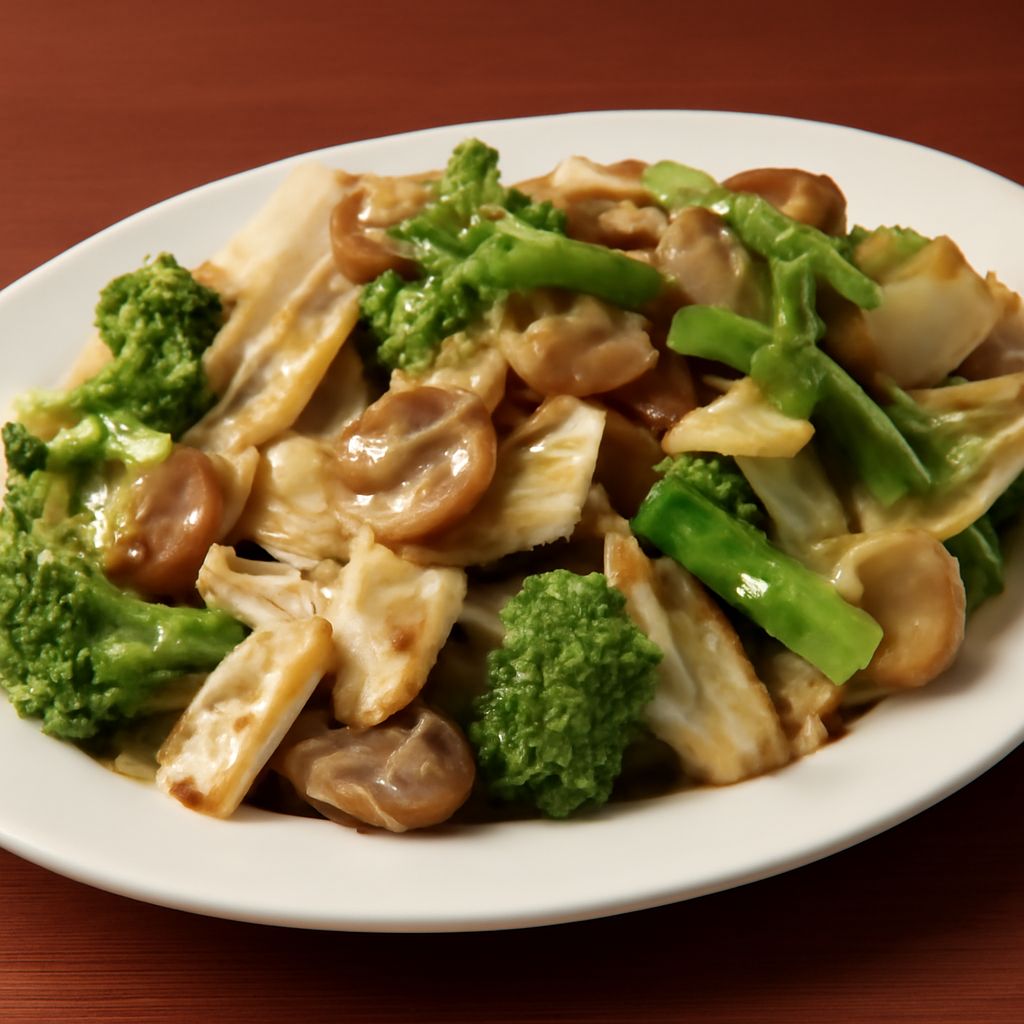
If you ask, “what is happy family chinese food?” the answer is a Chinese-American restaurant stir-fry that combines several proteins and assorted vegetables in a savory brown sauce. Chicken, shrimp, pork, and beef are common, but the exact combination varies by restaurant.
This happy family recipe serves four and uses crisp-tender vegetables, staged cooking, and a balanced sauce made with broth, oyster sauce, soy sauce, a little sugar, and rice wine.
What Is Happy Family Chinese Food?
Happy Family usually means a mixed-protein and vegetable entrée rather than one specific ingredient list. A restaurant may combine chicken, pork, shrimp, and beef, while another may use scallops, squid, or only two or three proteins. The shared idea is variety: tender meat and seafood are tossed with colorful vegetables and finished in a glossy brown sauce.
Because each protein cooks at a different speed, the best version is prepared in stages. Dense vegetables go into the wok first, delicate shrimp goes in last, and everything finishes together briefly in the sauce.
Happy Family Chinese Food Ingredients and Brown Sauce
The sauce should coat the ingredients without making them soupy. Broth keeps it pourable, oyster sauce adds depth, soy sauce supplies salt, and brown sugar rounds out the savory flavors. Shaoxing wine or dry sherry adds a subtle restaurant-style aroma. Cornstarch thickens the sauce only after it reaches a simmer.
Whisk the sauce before you start cooking so the cornstarch stays evenly distributed. Have every ingredient sliced and ready because stir-frying moves quickly.
Happy Family Recipe: Measured Ingredients and Yield
Yield: 4 servings
- Proteins: 8 ounces boneless, skinless chicken thigh or breast, thinly sliced; 4 ounces pork tenderloin, thinly sliced; and 4 ounces peeled, deveined large shrimp.
- Quick marinade: 1 tablespoon soy sauce and 1 teaspoon cornstarch, tossed with the chicken and pork.
- Vegetables: 2 cups small broccoli florets, 1 medium carrot in thin slices, 1 cup sliced mushrooms, 1 bell pepper in strips, 1 cup snow peas, and 1/2 cup baby corn.
- Aromatics: 3 minced garlic cloves and 1 tablespoon grated fresh ginger.
- Brown sauce: 1/2 cup low-sodium chicken broth, 2 tablespoons oyster sauce, 1 tablespoon soy sauce, 1 tablespoon Shaoxing wine or dry sherry, 1 teaspoon brown sugar, 2 teaspoons cornstarch, and 1/2 teaspoon toasted sesame oil.
- For cooking: 2 tablespoons neutral oil, divided, plus 2 tablespoons water. Serve with cooked white or brown rice.
Cook Proteins and Vegetables in Stages
- Prepare the ingredients. Whisk all sauce ingredients in a bowl. Toss the chicken and pork with the marinade and let them stand for 10 minutes. Keep the shrimp separate and dry.
- Sear the proteins. Heat a wok or large skillet over medium-high to high heat. Add 1 tablespoon oil. Stir-fry the chicken for about 2 minutes, turning once, until nearly cooked; transfer it to a plate. Add the pork and cook for 1 1/2 to 2 minutes, then remove it. Cook the shrimp for about 60 to 90 seconds, turning once, until just beginning to turn pink. Remove it as well. Work in batches if the pan looks crowded.
- Cook the firm vegetables. Add the remaining oil. Stir-fry the broccoli and carrot with 2 tablespoons water for 2 minutes. Add the mushrooms and bell pepper and cook for 2 minutes more. Add the snow peas and baby corn for the final minute. The vegetables should look bright and feel crisp-tender, not limp.
- Combine everything. Push the vegetables aside, add the garlic and ginger, and stir for 30 seconds until fragrant. Return the chicken, pork, and shrimp to the pan. Whisk the sauce again, pour it in, and toss for 1 to 2 minutes, until bubbling and glossy. Continue cooking until the chicken reaches 165°F, the pork reaches 145°F, and the shrimp is opaque and firm.
Finish the Stir-Fry and Make Smart Substitutions
Serve the stir-fry immediately over about 4 cups cooked rice. The finished sauce should cling to the proteins and vegetables. If it looks thin, simmer for another 30 seconds; if it becomes too thick, loosen it with 1 tablespoon water. Dull, soft vegetables usually mean the pan was crowded or they cooked too long.
- Replace the pork with thinly sliced flank steak, cooking it for about 1 minute per side, or use 12 ounces pressed firm tofu, seared first.
- Swap the broccoli, mushrooms, or snow peas for bok choy, asparagus, water chestnuts, or baby corn while keeping the total vegetables near 5 to 6 cups.
- For a vegetarian version, use vegetable broth and mushroom sauce instead of chicken broth and oyster sauce.
- For a gluten-free dish, choose gluten-free tamari and a certified gluten-free oyster or mushroom sauce.